|
When I did my re-introductory post a few weeks ago, I asked for suggestions for blog post topics in the comments. Today, I decided to tackle one from Tony Manfredonia that definitely was a challenge for me to blog about! He commented with:
“What I’d love to hear is if you’ve ever come across a piece (even if you leave it anonymous) that you played, you weren’t fond of. New music, particularly. Was it commissioned? Were you assigned it? I’d simply love to hear if you’ve ever struggled with “enjoying” a new piece of music and how you handled it.” On a post that asks about overcoming the challenge of not being fond of a piece, I should probably preface this with the general notion that I desperately seek connection to any piece I play even if I’m not fond of it Even in pieces that I absolutely adore, I’m constantly seeking a deeper connection with it. That’s something which is central to me as a performer- I’m always seeking to know a piece better so I can share it more fully. I’ve done a number of sometimes (crazy) things and found connections that may seem tenuous, but they speak to me so I can “speak” the piece for an audience. So, if I’m seeking connection in something I love, you’d better believe I do the same even more fervently for a piece I just “don’t get” yet (and I believe yet is ALWAYS the key word in this case). In my younger days (read: 10+ years ago), I struggled to connect with Mozart. I thought his music was too happy and not emotional enough. It didn’t make me feel enough, anyway. I was THAT person who would very loudly proclaim to my friends how much I didn’t enjoy his music when I was “stuck” playing it. His 5th violin concerto in particular was especially difficult for me to appreciate even though it’s an absolutely wonderful piece of music. However, when I studied the 4th violin concerto a couple of years later, something clicked with me because I was the same age as Mozart was when he had written that concerto. Suddenly, everything about it seemed more relatable. Since then, I’ve held a high regard for that concerto and, more importantly, a greater respect for Mozart. I still don’t actively seek out his music to listen to or play (although I love his chamber music now), but I have a much greater appreciation for the nuance and operatic drama that infuses his work. I share this particular example because, though I’ve often struggled to appreciate many pieces of new music, it’s more about lacking a connection with the piece or composer than finding an aesthetic difficult. I’ve had a number of challenging pieces written for me over the years. Some I absolutely loved even though I struggled to figure out how to inflect the phrasing so I could bring them to life. Some, I desperately wanted to love, but found that I couldn’t wrap my mind around form or phrase. Still others were so personal that I had to explore emotionally painful things for me and the composers who wrote them for me. I remember once that I struggled to connect with a piece, but a timeline forced me to play it before I fully understood it. I felt awful because it felt so unfinished even though I put everything I had into the piece. I knew the composer and respected how he talked about music so a personal connection wasn’t the problem. With all of the analytical tools I had available to me at the time, I did the best I could. I looked at form, planned gestures, and made comparisons to actions in my life that bring me clarity (journaling). I still wasn’t satisfied with my performance. Thinking about this topic, I still feel guilt about “leaving something on the table” with that piece although I’m not sure I could have done anything differently. It comes down to being willing to find that connection. You may never like a piece even if you desperately want to. It feels awful if it’s written for you and you don’t like it, but you can’t force yourself to like a piece that you just…don’t. However, if you refuse to challenge yourself to delve deeply into it anyway, you’re doing yourself and your collaborator a terrible disservice. Here’s my advice when faced with a piece of music you just “don’t get”: 1. Be willing to look for connections. You’d be willing to do it for pieces by some dead guy you never knew, how much more should you do be willing to find connections for a piece written by someone in your life? I promise that you’ll find something. Even if it helps with the smallest portion of the piece, it’s helpful. 2. Do the thing that seems crazy to understand a piece. I once practiced a piece based on a yoga vinyasa in the poses as much as possible (there’s photographic proof on instagram if you’re willing to look back that far). Standing with my legs in Warrior 2 (I couldn’t extend my arms out since I was playing) was surprisingly helpful for understanding the phrasing in that particular section. 3. Be willing to go to difficult emotional places. There have been a couple of pieces written for me that have felt so personal that I was taken aback by being given that kind of emotional content. I’ve learned that if a collaborator chooses to write a particular piece for you, they trust that you’ll say what they give you when you play their pieces. It’s a privilege so don’t take it lightly. Performers, what have you done to help connect with a piece of music you “don’t get?” Please share your advice in the comments below! If you liked the change of pace in topics from my list (yes, I keep a list that I want to write about), leave me a suggestion. I’ll probably use it. :)
1 Comment
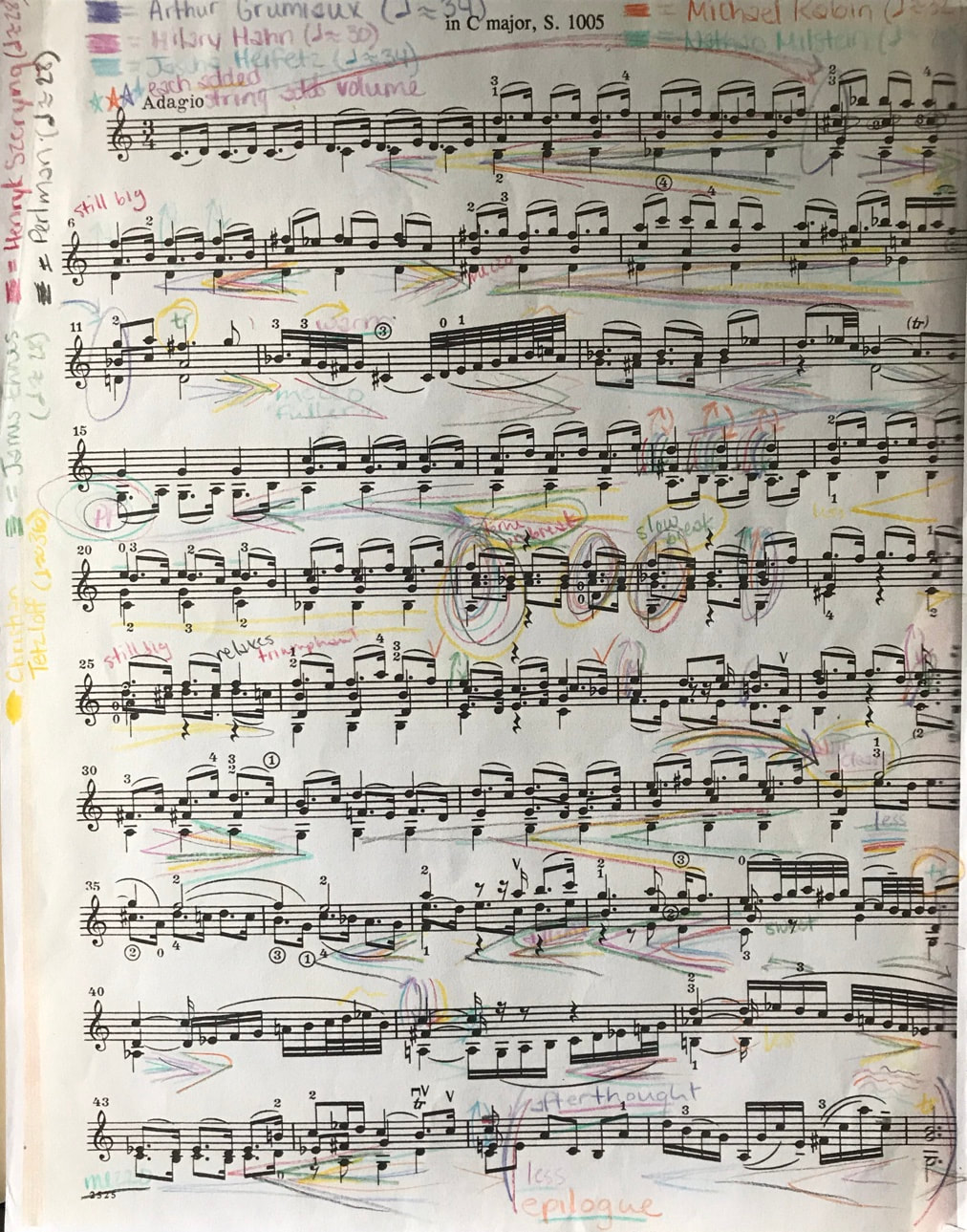
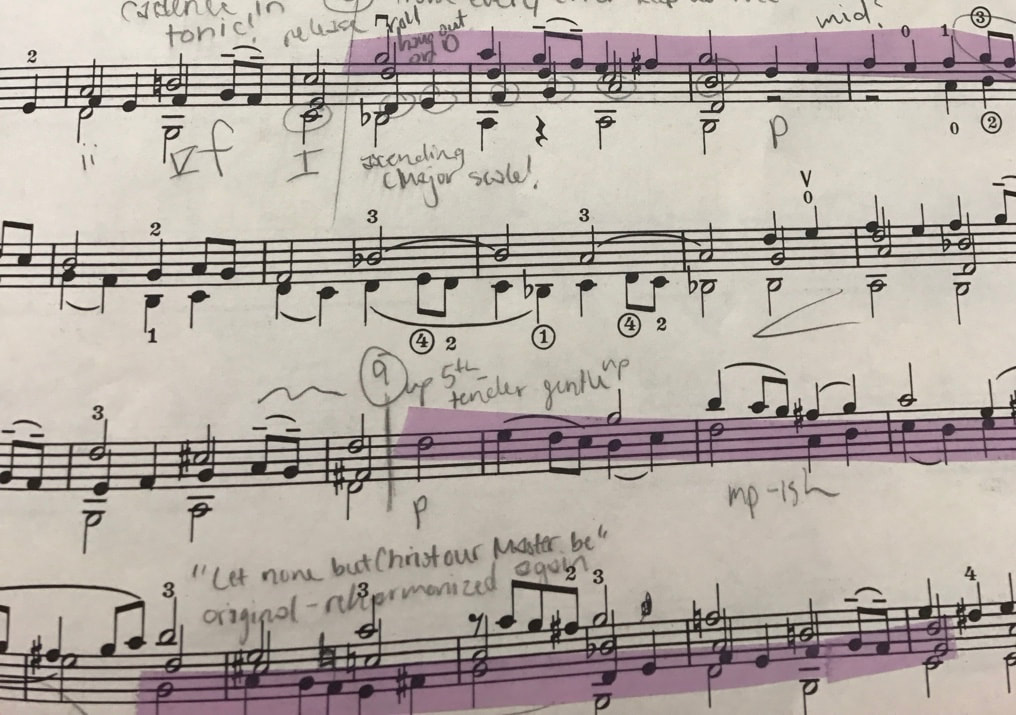
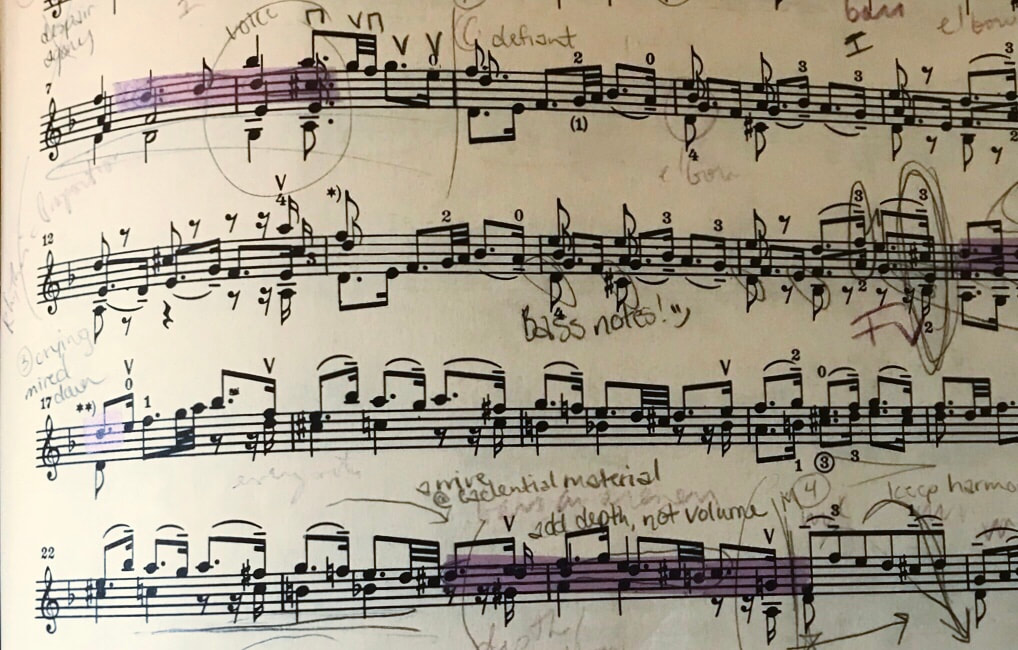
One of my favorite ways to provide a visual reminder for what I’d like to prioritize is using highlighter tape. When I was younger, I used it to mark difficult passages that needed more attention in my practice. I loved it because, when I felt like I had sufficiently addressed any issues, the tape was removable and I could clear my score without damaging it! I also found that I could write on it in pencil so it didn’t hinder my usage of the score in any way. As I began studying my first solo Bach fugue, I used the tape to highlight the fugue subject or fragments of it. By drawing my attention to it visually, I was able to prioritize bringing it to the foreground of the texture when it was buried within chords (hey look, I’m talking about voicing again in solo Bach…go figure!). More recently, I’ve been using it while re-visiting the Chaconne from the d minor partita. The treatment D-C#-D motion in cadential progressions is fascinating to me and often the most interesting voice to my taste. The pitch I most associated with consonance and release reaches the height of tension in these progressions such that the leading tone is heard as relief to it. So, to make sure I draw the ear toward this progression throughout the piece, I’ve marked them all with highlighter tape so I know what I want to bring to the foreground.
It’s all too easy to become overly cerebral with these exercises and get so caught up in the detail that the musicality becomes lost. However, I’ve found that by looking this closely at the score away from my instrument, I’m left with a clearer understanding of the musical inflection I want to craft. Side note: I need to give a huge shoutout to the Parker Quartet for talking about “inflecting” phrases during their masterclass for the University of Iowa String Quartet Residency Program on Monday- I’ve been mulling over how perfect that term is for what we do ever since then and I’m so grateful for the inspiration. By focusing on these details, I’m often led to larger-scale musical questions. Here are some examples: 1. How does the register of the fugue subject and the key area its in influence the character? 2. In what ways do the qualities I associate with the strings of my particular violin inflect the general character of a passage? 3. How does the texture of a particular passage influence my dynamic level? My answers to these and other questions directly guide my inflections on a piece. When I approach the piece with my violin again after taking the time to study it in one (or more) of these ways, my inflection on the piece is much more clear. Rather than fighting the score, I’m working with it for a more nuanced performance. What are some ways studying scores has benefited your practice? What are some techniques you use? Composers, do you leave any “easter eggs” in your music for discerning performers to find, or are they subconsciously placed? Please share in the comments section!
|

Archives
November 2018
Categories
All
|
 RSS Feed